My Blog has moved!

Thanks for visiting, but my blog has now moved to a new home at www.davidmillard.org, if you have javascript enabled you should automatically be redirected to the right place, if not then please follow the link directly to my new home page.

Showing posts with label web science. Show all posts

Thursday, November 25, 2010

Rise of the Other Web

Isn't the Web great? Isn't it crazy and anarchic, vibrant and wild, unpredictable, awesome and thoroughly marvelous? Well it has been, but there is no guarantee that it will stay that way.

I've been working with and researching Hypertext for nearly fifteen years. The Hypertext systems that I studied for my PhD were alternative contemporaries of the early Web - based on a desktop model and inter-operating applications. But since that time we've seen the Web take Hypertext away from the desktop and make it global. The Web we have built is democratic and open; anyone can publish, and most importantly anyone can link. For profit, for criticism, for fun, for ill, the technologies of the Web do not judge or distinguish.
there is a new trend that threatens the democratic and egalitarian nature of the Web...
For a while there we all went a bit Web loopy, remember Microsoft's incredible about turn when they discovered the Internet and tried to turn your desktop into a Web browser? And of course there is the current crop of Web Applications, point your browser at docs.google.com and it turns into a collaborative text editor.

But there is a new trend that threatens the democratic and egalitarian nature of the Web. It plays to consumerism and relies on technical naivety. It is the App Store.

I must concede that the Apple App Store is brilliantly executed. Apple weren't the first to think of making a library of downloadable components but they were the first to make it truly usable and in the process defined a whole new vocabulary for everyday users. 'There's an App for That' is now a part of popular culture and I admire it enough that we are borrowing the whole meme for some of our own systems.

So Apps are great for extending the functionality of a device but the worrying trend is for information providers to use mobile Apps to encircle information and provide it to you neatly packaged, but crucially outside of the Web and all its egalitarian mechanisms. This trend is set to continue as providers realise that Apps include a handy micro-payments system that means they can charge for content again. You can almost hear the sound of old business models being wheeled out and firing up their antiquated boilers.

To some extend this is positive, after all professional journalists and artists are all part of a healthy society, and we need to find ways of supporting their work. But I worry that the commercial pressure to do this will create a generation of isolated tools that take but do not give back. The App model has been so commercially successful that Apple is threatening to roll it out to their MacOS platform, and what Apple does today, Microsoft will do in five years time, and if that happens this kind of control could well become the norm across all of our computing devices.

We should be very nervous about the impact of all of this on the Web. In the nineties it was the digital home of geekdom, but its got a lot more interesting since everyone else joined the party. It would be a shame to go back.

Tim Berners-Lee highlights this problem in his latest Scientific American article (amongst other concerns with Net Neutrality and Openness):

"Other companies are also creating closed worlds. The tendency for magazines, for example, to produce smartphone “apps” rather than Web apps is disturbing, because that material is off the Web. You can’t bookmark it or e-mail a link to a page within it. You can’t tweet it. ... But as we saw in the 1990s with the America Online dial-up information system that gave you a restricted subset of the Web, these closed, “walled gardens,” no matter how pleasing, can never compete in diversity, richness and innovation with the mad, throbbing Web market outside their gates."

His point is that the 'Other' Web created by the App model is not a Web at all. Just the opposite - it is isolated, singular, and barren in comparison. Cartoonist Hugh Macleod makes the same point more bluntly:


The challenge for computer scientists (or should that be Web Scientists) is to work out how to work the benefits of the App Store into the open web, thus protecting it from the closed model. This should probably include the quality of the user experience (HTML5 may address some of this) and the need for an efficient micro-payment model has never been so pressing. 

But perhaps we should also challenge some of our assumptions - for example, the web browser may not be the only portal onto the wonderful web world, there may be a place for more specific applications that play nicely and use Web standards in a broader web ecology, downloadable Apps that are URI addressable, and which switch you seamlessly from one App to another.

Come to think of it,  that sounds a lot like good old fashioned Open Hypermedia - perhaps History will be kinder than we all expected :-)

Friday, September 17, 2010

Choosing our Science: Hypertext and Web Science

This blog post is an abridged version of a guest editorial I co-wrote for the New Review of Hypermedia and Multimedia, Special Issue on Web Science. The full editorial can be found in EPrints.

Hypertext and the Web

What is Hypertext? It is well known in our community that the word Hypertext was coined by Nelson in 1965 to describe his vision of an intertwingled world of transcluded electronic texts, but we also know that the ideas and principles of Hypertext predate electronic computers. Writers and scholars have always experimented with interlinked texts, from the Talmud and the Synoptic Gospels to Borges’ Garden of Forking Paths. Well’s World Brain, Otlet’s Mundaneum and Bush’s memex set out grand visions for global stores of human knowledge based on index cards and microfiche.
The Hypertext Pioneers (Bush, Engelbart and Nelson)

Despite these broad origins Hypertext has come to be seen almost exclusively from a digital viewpoint, perhaps because of its many synergies with key concepts from informatics and computer science, such as networks, communication theory, and knowledge modeling. But Hypertext is more than digital. It predates computers and predates computer science. Any broad approach to hypertext must therefore be interdisciplinary, even if keeping one foot in the digital domain.

The Web is the closest that we have come to the grand visions of the hypertext pioneers. From unpromising beginnings as a basic read-only distributed hypertext, the Web has evolved over the last twenty years into the premier distributed application platform. As a platform it supports a whole ecology of hypertext tools and forms: versioned collaborative hypertexts (Wikis), bookmarks and trails (Delicious or Digg), citizen journalism (blogs and sharing sites) and social conversation and chatter (Facebook or Twitter). As a hypertext it disappointed and confounded us, but as a platform it has excited and renewed hypertext research.

A Science of the Web

Web Science is a new discipline that is concerned with the study of the Web and our behavior on it. Web Science draws on a wide range of traditional disciplines (such as sociology, economics and law) to understand, model and predict the Web’s impact on our lives and societies. Through Web Science the hope is that we can better understand the affects of different technology, and the changing attitudes and social norms that emerge from its use. The aim is to better guide new developments in both technology and policy.


Web Science was first proposed by Tim Berners-Lee et al in an article for Science (in 2006), this then led to the establishment of the Web Science Research Initiative (now the Web Science Trust ) an agreement between MIT in the US, and the University of Southampton in the UK, to explore and promote the study of the Web; in particular by developing curricula for Web Science and through establishing the Web Science conference (held for the second time this year in Raleigh, North Carolina).

As the Web has become an essential service in our society, so hypertext has become an essential tool of communication and interaction. If we accept that the Web is an ecology of hypertexts and that Web Science is the interdisciplinary study of the Web then we should expect that Web Science and Hypertext are natural bedfellows. It was this thought that led us to ask what is or should be the relationship between Hypertext research and Web Science.

In 2008 we ran a workshop at ACM Hypertext 2008 on ‘Web Science: Collaboration and Collective Intelligence’. In part we were interested in what aspects of its Hypertext work that the community also considered as Web Science. The workshop was the largest at the conference, and ten position papers were presented on the day on topics ranging from trust and media bias to narrative structure.

There was a great deal of interest from participants about the idea of Web Science, but there was also uncertainty. Computer Science is itself a hybrid discipline – engineering, mathematics, logic, human factors, semiotics and semantics, etc. Where were the boundaries of this new discipline of Web Science, were new tools based on interdisciplinary theories part of it, and at what point was it appropriate to call ourselves Web Scientists?

Are We Web Scientists?

The papers in the Special Issue concerned with Web Science in-the-small, the personal relationships that we have with information and knowledge, are on topics that are historically familiar to Hypertext research: meta-data, knowledge interfaces and narrative. Hypertext researchers should feel very comfortable exploring these issues and perhaps the emergence of Web Science is partly a reflection of our willingness to explore new interdisciplinary areas that draw on a wider range of the humanities in order to understand the relationships between users and hypertext systems.

The huge success of the Web has meant that it is possible to do Web Science in-the-large, and we also present a number of papers that study the impact of Web systems on professional and personal communities, and analyze the social structures that result. These are new areas of possibility for Hypertext researchers and represent an opportunity for new longitudinal studies and the use of statistical research methodologies.

Hypertext research is naturally growing and evolving to reflect the pervasiveness of the Web and to take advantage of a changing interdisciplinary scientific culture. These changes take it closer to Web Science, and there are many overlapping areas where Hypertext is a valuable lens with which to examine the impact of the Web. However, Hypertext remains its own subject, with its own long intellectual and scholarly history.

In the end it is our choice as researchers as to whether we choose to name what we do as a Science of the Web, or ultimately brand ourselves as Web Scientists. In making that choice we should remember that Web Science is more than rebadging existing work. Interdisciplinary research can be difficult to communicate, and by using a strong term like Web Science we create a clear space for interdisciplinary research approaches, one that encourages us to explore in new ways and to think more holistically about our subject.

Wednesday, November 18, 2009

Knowledge Ergonomics (That Thing We Do)

For the last few years I've been involved in research and development projects where the goal has been to design, build and evaluate useful and useable knowledge and information interfaces. But I've always had a problem articulating this as a research challenge. It's related to Human Computer Interaction (HCI) but isn't so much concerned with surface details or visual interfaces, but seems an inherently deeper problem - how does the system match with working patterns, are the information models at the right level for users, is the workflow aligned with what they do?

For example, when designing mobile tools for placement learners the MPLAT Project ran into the well known problem of co-design. The technologists don't understand the domain well-enough to design an appropriate fit, but the domain-experts don't understand the technology well-enough to be truly innovative. I once heard this described as the Problem of the Robot Horse, a fictional scenario where scientists from the 1700's are asked what vehicle they would build with modern technology, and all they can think of are robot horses - because a horse is all that they are familiar with.
In MPLAT we developed an extensive co-design and co-deployment methodology to try and enable innovative but informed design. HCI is not the right name for this research, it's about new processes of system design that incorporates elements of HCI in its core, some other phrase is needed.

In the FREMA project we experimented with a Semantic Wiki (a wiki where pages and links have types) to see if a community folksonomy (the set of types authors chose) would converge over time into anything resembling a designed ontology.

Through experimentation we showed that while creative interfaces helped authors, it was seeding the wiki that had the most significant effect on the quality of the emerging structure. This work was all about how communities expressed their knowledge, and how much they were aware of the process of knowledge construction. It certainly has elements of HCI to it, but again the term HCI doesn't capture it accurately.

As a final example consider the work we've done most recently on trying to redesign teaching and learning repositories, by examining how teaching repositories differ from research repositories, and exploring what elements of Web 2.0 design are most appropriate for them. Our more theoretical starting point led us to reject many of the commonly held beliefs about Learning Objects and repository design, resulting in a number of emerging repository installations that have a radically different feel to them (such as EdShare and HUMBox).

Once more our approach goes beyond interface design, and includes a number of more holistic factors, such as balancing the meta-data needs of the system with the tolerance of the users, and aligning the purpose and services of the software with potential users. If the term HCI is to broad to capture this, then what does?

This problem came to a head for me recently when I had to present our repository work at the first EdShare workshop. I needed to somehow express this process of aligning an information system with its users, in terms of both workflow and knowledge.

As a happy coincidence I happened to mention some of this work (in an entirely unrelated conversation) to Stephen Thomas from the School of Management, and he noted that it sounded a lot like ergonomics - the science of designing equipment (normally physical equipment) to fit the user. A few googles later and I had introduced myself to the discipline of Cognitive Ergonomics - the science of designing equipment to fit the mind - and the concept of Macroergonomics - a broad view of ergonomics that includes environmental and cultural factors.


So perhaps the work that we do is best described as a type of cognitive or Knowledge Ergonomics - the science of building knowledge structures and systems that fit the ways in which the users of those systems conceptualise, express, communicate, process and use knowledge.

In simpler words: building systems that better fit how people think.

Thursday, June 26, 2008

ACM Hypertext 2008 and Web Science Workshop

Update 27-10-08: A more formal version of this blog entry appeared in the SIGWEB Newsletter as the Hypertext 2008 trip report. You can find the full text as a pre-print in the ECS e-prints repository.

I've just got back from this years ACM Hypertext Conference in Pittsburgh, PA. Hypertext '98 was also in Pittsburgh, that was my first academic conference, and also my first trip to the States, so it was interesting to head back there. Pittsburgh seemed smaller this time around, and the culture shock was missing - either Pittsburgh is more European that it was (certainly there are a lot more European style cars crawling about) or I've just gotten used to America (in the ten years since I've been to a lot other states, and some of them like Texas and Florida are as different from the East Coast as the East Coast is to the UK).

Hypertext is always a fun event and this year the conference was looking healthier than it has for a long time, good local organisation and an impressive conference dinner on Mount Washington overlooking the city certainly helped, but the main reason was probably that the CFP was broadened to include Social Linking. This has brought in a whole new side of the community, resulting in a great mix of papers. As I pointed out in a short paper of my own a few years ago, Web 2.0 style interaction was at the heart of Hypertext systems before there was even a Web 1.0, and so its strange that the conference doesn't already attract more people from the world of Blogs, Wikis, Tagging, Social Networking and so forth. Hopefully this event marks a turning point and the trend will continue in the future.

Defining Disciplines

My main role at this years conference was as the Workshops Chair, I also stood in for Weigang Wang as Chair for the Web Science Workshop, which was very well attended (20 people in total). Web Science is a new discipline proposed by Tim-Berners Lee, Wendy Hall and Others, and is concerned with the study of how the Web interacts with People and Society. I think its useful to think in terms of Web Science, but was aware that there a lot of people already working on topics in this area, and saw the workshop as a chance for them to get involved, and start to take some ownership of the idea.

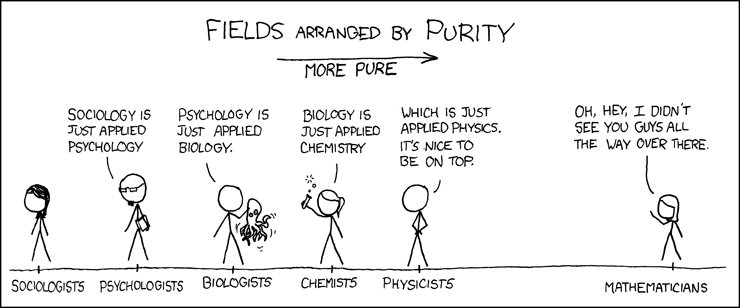
A variety of work was presented and we spent some time discussing the difficulty of defining a new discipline, with the observation that it is often as useful to think about what it isn't, as well as what it is.


My PhD student Charlie pointed me to the cartoon above that neatly summarises some of the difficulties. Defining disciplines certainly isn't easy, we even got sidetracked into a discussion about whether Computer Science was a subset of Information Science or if was it the other way around! For me the real challenge for Web Science will be when people start to design undergraduate courses, because at that point it needs to stand separately from other disciplines (and Computer Science in particular). At least in the meantime we know its a subset of Mathematics :-)

Does Hypertext Work?

Although he was beaten to the best paper award, I was most taken by David Kolb's excellent paper and presentation 'The Revenge of the Page' that examined the viability of complex hypertexts 'in the pitiless gaze of Google Analytics'. David had created a new complex hypertext work, available on the Web, with a mix of sophisticated hypertext patterns (of links) designed to affect the readers experience (using techniques such as juxtaposition and revisiting). However Google's stats told him that few visitors lasted more than a few seconds, the majority were coming via Google Images looking for photos, and even when these were factored out visitors only stayed for a minute or so. It certainly sparked some interesting conversations about the viability of nuanced hypertexts, the unexpected arrivals that result from search tool indexing, and whether hypertext is fighting a 'quick-fix' media culture that is prevalent on the Web, and may even be spreading into normal media.

It made me reflect on the sad state of Web-based hypertexts. I wonder if the problem is two-pronged, that most readers don't have any accessible examples of readable hypertexts, and that there are no popular tools to create hypertexts (saving perhaps Tinderbox).

The hypertext authoring tools that are used by millions of people are mostly Wikis and Blog editors, and these encourage only exit links created around a single article page (exit links are links that take the reader elsewhere, perhaps to supplementary material, rather than to another part of the same work).

For example, this is a pretty long blog entry, so why is it written as a single article, why not as a hypertext?

I suspect that along with the tools it is familiarity that breeds this kind of linear article. After all I spent my childhood writing linear stories, and my adulthood writing linear papers. There is a growing body of classic hypertext fiction, but most of it is challenging, and has never been seen by most readers. Maybe we need more easily accessible hypertext works (along the lines of 253) so that readers get used to seeing hypertexts, and understand what to do with them. In the end that is the only way that they are ever going to actually write them.

Trends

Despite David's gloomy experience the overall feeling of the conference was positive, however there was no Grand Vision underpinning the presentations, and much more analysis of what's already happening, rather than any looking forward to the next big thing. Perhaps the community has already been stung (Open Hypermedia for example), or maybe there is just so much activity in the Web 2.0 space already, that it's as much as we can do to monitor and evaluate things - without adding to the madness ourselves.

One topic that was very noticeable in its absence was the Semantic Web. In previous conferences much has been made of it, both in terms of a long term Web 3.0 candidate, but also in a number of practical applications. So why the low profile? Could it be that the Semantic Web has quietly arrived already, or is it that the world has moved onwards, and the Semantic Web is no longer a convincing vision?

My feeling is that the Semantic Web has already arrived, but with a whimper rather than a bang. Its concepts underpin a lot of the work that is happening in the Web 2.0 world (Semantic Wikis and Folksonomy research for example), and the standards are being used in anger for many knowledge-base systems and mash-ups, but it's not common enough for its use to be widely analysed. Perhaps it never will be.

I've been studying this stuff for long enough now to realise that sometimes a technology succeeds, and sometimes it merely inspires. What we have now isn't very Semantic, and its not really a Web either - but it is certainly in the spirit of the original vision (there's that word again).

So perhaps the relationship between the Semantic Web and Web 3.0 will be similar to the relationship between Hypertext Systems and Web 2.0. That would be interesting, as the genealogy (memealogy?) from Hypertext to Web 2.0 is rather tortuous, and full of painful extinction and reinvention. I suspect that the Semantic Web is rather better placed to be transformed from research darling into popular technology (due to a well defined stack of standards), and that Web Science may actually help the process.

The Hypertext conference is a good place to find out :-)

Wednesday, March 14, 2007

Sir Tim

Is it just me, or at the mention of Sir Tim does everyone look around nervously for the vicious Chicken of Bristol? Brave, brave, Sir Tim Berners-Lee - the inventor of the Web - is a Professor at the University of Southampton, and I've just returned from his Inaugural Lecture on the past and future of the Web.

Despite his growing geek-fame, and the commercial temptations it must have brought, he has admirably stuck to his original vision of the Web as a broad, open, free and democratic system. Much of the message of his talk was on the importance of understanding the impact of the web, and promoting Web Science as the new inter-discipline that would enable this.

For those that haven't met him, he is a very English scientist, despite the mid-Atlantic accent that he occasionally drops into (he now lives and works mostly at MIT in the States). Actually he reminds me somewhat of portrayals I've seen of Alan Turing - quiet and unaffected. What I like about Tim Berners-Lee is the high level view that he has taken of his creation, and the understated way in which he talks of its importance. If he hadn't created the Web then I suspect that one of the other hypertext systems evolving at the time would have eventually focused on distribution and taken off instead, so Sir Tim's real contribution is not technical, but political; he gave his creation away unpatented and for free, and not in error, but intentionally, to make the world a better place.

If only a certain Mr Gates had taken the same view then the world might be very different. If you're reading this Sir Tim, then thanks for the Web - it's jolly good - and remember that the capital of Assyria is Nineveh!