My Blog has moved!

Thanks for visiting, but my blog has now moved to a new home at www.davidmillard.org, if you have javascript enabled you should automatically be redirected to the right place, if not then please follow the link directly to my new home page.

Tuesday, July 8, 2008

Free, as in Web Designs

This month I discovered the wonders of free web design. I'm not sure why it never occurred to me before, but it turns out that there is a blossoming community of web designers out there who are in it for the glory, and who make their designs available on sites such as OSWD.org. You can browse the libraries and download a zip package of html templates and css files that you are then free to modify for your own use.

I took the opportunity to revise my own tired homepage, currently celebrating its 12th year of vanity and anonymity, using a design from Node Three Thirty Design (not much on their own page, but there are links to DeviantART and Zeroweb as well).

My website started back in 1996 with a coursework for my degree (on a module which I now run - who says life isn't a circle :-/

The text is probably too small to read, but it's an on-line technical report on digital video. The last bit reads:

"New advances both in compression and storage have meant that TV quality pictures and even High Definition TV pictures could soon be possible and in lengths that would enable people to watch entire movies on their monitors. These benefits are so great that even the average media consumer could soon see digital television sets in their homes.

Add to this the ability to transmit video across a network (or the internet) and video conferencing and video phones also seem to be a possibility"

Honestly, any more prophesy and I'd be growing a straggly beard, plucking juniper bushes from thin air, and running around following the gourd.

During my PhD I built a homepage that was a kind of a 2d bookmark manager, there was some information about me, but mostly it functioned as a personal hypertext, and a place to put public material (such as teaching notes):

At some point it occurred to me that having some handy search forms on my home page would be a good plan, and so when I became a Research Fellow I added a side bar to search a number of common sites (this was before the days when search had been integrated into browsers):

If I'd been paying attention I might have generalised this and called the result pageflakes or iGoogle, but I was too busy doing worthy things with Open Hypermedia, and by the time I looked up the boat wasnt even on the horizon any more.

When I became a lecturer I needed a homepage that better reflected the work that I was doing, as well as functioning as a homepage for my own browser. I therefore set about a re-design, and incorporated this blog as aggregated content:

Undeterred by my iGoogle experience I followed Ted Nelson's example and proceeded to invent other potentially profitable tools to ignore, including a news aggregation page that I kept until Google Reader came along and showed me better:

This website was altogether better structured, with proper delimited sections, a decent page layout, and a design encoded using CSS (although I did cheat and use tables). This design has worked really well for over a year now, but in the Spring I noticed something unfortunate about it - it looks like it was drawn by a six year old :-(

The problem is that I just dont have time to do a better job - that would require evenings spent lovingly drawing slightly curved corners and dabbling in CSS voodoo. I was getting despondent - but then came across the Free Web Design People at OSWD, and within a few hours I had a shiny new website. Ok, it took a bit longer to glue the various parts together, and I didnt escape some minor CSS witchcraft, but nothing worth burning anyone over. The result is my current design:

I'm not entirely happy with the moody black and white picture (and my wife thinks it makes me look like I've had a stroke :-( but I'm proud of the fact that despite the fact that I have a Mac now, my homepage photo doesn't involve a polo neck shirt.

So the lesson here is that busy geeks of the world you need toil no more! Friendly graphic designers have rescued you from your tardy prisons and 90's vi coded html.

You are free (as in Web Design)!

Thursday, June 26, 2008

ACM Hypertext 2008 and Web Science Workshop

Update 27-10-08: A more formal version of this blog entry appeared in the SIGWEB Newsletter as the Hypertext 2008 trip report. You can find the full text as a pre-print in the ECS e-prints repository.

I've just got back from this years ACM Hypertext Conference in Pittsburgh, PA. Hypertext '98 was also in Pittsburgh, that was my first academic conference, and also my first trip to the States, so it was interesting to head back there. Pittsburgh seemed smaller this time around, and the culture shock was missing - either Pittsburgh is more European that it was (certainly there are a lot more European style cars crawling about) or I've just gotten used to America (in the ten years since I've been to a lot other states, and some of them like Texas and Florida are as different from the East Coast as the East Coast is to the UK).

Hypertext is always a fun event and this year the conference was looking healthier than it has for a long time, good local organisation and an impressive conference dinner on Mount Washington overlooking the city certainly helped, but the main reason was probably that the CFP was broadened to include Social Linking. This has brought in a whole new side of the community, resulting in a great mix of papers. As I pointed out in a short paper of my own a few years ago, Web 2.0 style interaction was at the heart of Hypertext systems before there was even a Web 1.0, and so its strange that the conference doesn't already attract more people from the world of Blogs, Wikis, Tagging, Social Networking and so forth. Hopefully this event marks a turning point and the trend will continue in the future.

Defining Disciplines

My main role at this years conference was as the Workshops Chair, I also stood in for Weigang Wang as Chair for the Web Science Workshop, which was very well attended (20 people in total). Web Science is a new discipline proposed by Tim-Berners Lee, Wendy Hall and Others, and is concerned with the study of how the Web interacts with People and Society. I think its useful to think in terms of Web Science, but was aware that there a lot of people already working on topics in this area, and saw the workshop as a chance for them to get involved, and start to take some ownership of the idea.

A variety of work was presented and we spent some time discussing the difficulty of defining a new discipline, with the observation that it is often as useful to think about what it isn't, as well as what it is.
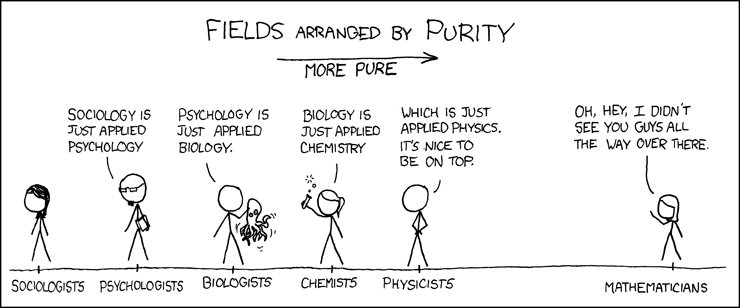

My PhD student Charlie pointed me to the cartoon above that neatly summarises some of the difficulties. Defining disciplines certainly isn't easy, we even got sidetracked into a discussion about whether Computer Science was a subset of Information Science or if was it the other way around! For me the real challenge for Web Science will be when people start to design undergraduate courses, because at that point it needs to stand separately from other disciplines (and Computer Science in particular). At least in the meantime we know its a subset of Mathematics :-)

Does Hypertext Work?

Although he was beaten to the best paper award, I was most taken by David Kolb's excellent paper and presentation 'The Revenge of the Page' that examined the viability of complex hypertexts 'in the pitiless gaze of Google Analytics'. David had created a new complex hypertext work, available on the Web, with a mix of sophisticated hypertext patterns (of links) designed to affect the readers experience (using techniques such as juxtaposition and revisiting). However Google's stats told him that few visitors lasted more than a few seconds, the majority were coming via Google Images looking for photos, and even when these were factored out visitors only stayed for a minute or so. It certainly sparked some interesting conversations about the viability of nuanced hypertexts, the unexpected arrivals that result from search tool indexing, and whether hypertext is fighting a 'quick-fix' media culture that is prevalent on the Web, and may even be spreading into normal media.

It made me reflect on the sad state of Web-based hypertexts. I wonder if the problem is two-pronged, that most readers don't have any accessible examples of readable hypertexts, and that there are no popular tools to create hypertexts (saving perhaps Tinderbox).

The hypertext authoring tools that are used by millions of people are mostly Wikis and Blog editors, and these encourage only exit links created around a single article page (exit links are links that take the reader elsewhere, perhaps to supplementary material, rather than to another part of the same work).

For example, this is a pretty long blog entry, so why is it written as a single article, why not as a hypertext?

I suspect that along with the tools it is familiarity that breeds this kind of linear article. After all I spent my childhood writing linear stories, and my adulthood writing linear papers. There is a growing body of classic hypertext fiction, but most of it is challenging, and has never been seen by most readers. Maybe we need more easily accessible hypertext works (along the lines of 253) so that readers get used to seeing hypertexts, and understand what to do with them. In the end that is the only way that they are ever going to actually write them.

Trends

Despite David's gloomy experience the overall feeling of the conference was positive, however there was no Grand Vision underpinning the presentations, and much more analysis of what's already happening, rather than any looking forward to the next big thing. Perhaps the community has already been stung (Open Hypermedia for example), or maybe there is just so much activity in the Web 2.0 space already, that it's as much as we can do to monitor and evaluate things - without adding to the madness ourselves.

One topic that was very noticeable in its absence was the Semantic Web. In previous conferences much has been made of it, both in terms of a long term Web 3.0 candidate, but also in a number of practical applications. So why the low profile? Could it be that the Semantic Web has quietly arrived already, or is it that the world has moved onwards, and the Semantic Web is no longer a convincing vision?

My feeling is that the Semantic Web has already arrived, but with a whimper rather than a bang. Its concepts underpin a lot of the work that is happening in the Web 2.0 world (Semantic Wikis and Folksonomy research for example), and the standards are being used in anger for many knowledge-base systems and mash-ups, but it's not common enough for its use to be widely analysed. Perhaps it never will be.

I've been studying this stuff for long enough now to realise that sometimes a technology succeeds, and sometimes it merely inspires. What we have now isn't very Semantic, and its not really a Web either - but it is certainly in the spirit of the original vision (there's that word again).

So perhaps the relationship between the Semantic Web and Web 3.0 will be similar to the relationship between Hypertext Systems and Web 2.0. That would be interesting, as the genealogy (memealogy?) from Hypertext to Web 2.0 is rather tortuous, and full of painful extinction and reinvention. I suspect that the Semantic Web is rather better placed to be transformed from research darling into popular technology (due to a well defined stack of standards), and that Web Science may actually help the process.

The Hypertext conference is a good place to find out :-)

Thursday, June 12, 2008

Bon Jovi at Southampton

Last night I went to see Bon Jovi play at St. Mary's Stadium in Southampton - it was the first UK date of their Lost Highway Tour.

My wife Jo and I don't really share the same tastes in music, she likes unbearable cat stranglers like Westlife and Enrique Iglesias, and I like bearable but LOUD cat stranglers like Muse, Metallica and Nightwish. Bon Jovi manage to sit in the very small overlap in our tastes, jostling for space on a tiny soft rock ledge with bands like the Kaiser Chiefs and the Hoosiers.

I bought us seated tickets for the event, but this turned out to be a mistake as the organisers seemed to get a bit confused, and when we arrived it turned out that my tickets were for seats that were actually behind the stage. Exactly what sort of spectacle they were hoping to provide when all we could see was the back of a speaker stack was unclear. Luckily the marshals didn't seem too bothered by us moving around, so when the band started playing we moved to stand in a walkway where could see as well as hear them.

bonjovigal15
(more pics on the St. Mary's site)

A local band kicked things off (Hours Til Autumn), and they actually did a pretty good job, especially since this was their first gig with more than a 100 people (29,000 in the stadium). The big disappointment was with the major support act - The Feeling are supporting Bon Jovi for half of their UK gigs, and we were hoping for a surprise support act in Southampton (Nickelback did the honours for them back in 2006, and Razorlight are doing their Ireland dates, so we had high hopes). Sadly the surprise was that there was no support act at all, and Bon Jovi came on cold at 8pm.

It was a good set, with just the right mix of classic stuff from their big 80's and 90's albums, and the better new songs from the Lost Highways album, but without a big support act out front they started pretty slowly, and it took a good hour for things to really get going.

The last hour was damn fine though and they managed to lift the stadium despite the drizzle. In fact I've caught myself humming a number of embarrassing soft rock classics this morning, so something must have clicked :-)

So a good night, even if the stadium should be ashamed of selling unusable seats (especially when the event wasn't sold out!), and even if Bon Jovi had to be their own warm up artists. If you're thinking of getting tickets for any of there other gigs - go for the ones where The Feeling are playing. Not only will you get an extra hour of crooning, but you're more likely to have got into the swing of things by the time Bon Jovi start their set.

Monday, May 12, 2008

OSX again and again

I came across this fabulous music video created by Dennis Liu using only Mac OSX - even if I hadn't switched I'd think this was brilliant:


I've been using the Mac now for almost two months and the shine hasn't rubbed off yet. Some of my earlier quibbles have disappeared as I've got used to the Mac way of doing things (most notably the additional Command key, and the missing right mouse button), and I've got to appreciate some other really nice features (like Preview, Spotlight searching and universal spell checking).

I've also come to regard Windows with a bit more tolerance as a low cost, hardware agnostic, public spirited OS. I've been trying to come up with analogies that do the difference between the two systems justice, and the one that best captures my thinking now is that Windows is a bit like social housing - its definitely something that I think should exist and be made available to those people who need it, but if I was completely honest I'd rather have my own place ;-)

Thursday, May 8, 2008

Thanks to the unique way the BBC is funded...

Over the last few weeks the BBC have been running what at first seems a trailer for Panorama. In the trailer a camera pans over dimly lit streets of circuitry, diodes flicker like broken lamps, and sink estates wallow in the shadows of tall capacitors. "Your town; your street; your home..." the narrator threatens, "its all in our database."


The viewer raises an eyebrow, expecting some shocking revelation about Orwellian government schemes to combat terrorism, or ineptitude over social service data - in short, expecting the pitch for a documentary about sinister forces working to subvert our liberties - but then the punchline comes: "new technology means that its easy to pay your TV license, and impossible to hide it you don't. Its all in the database."

WHAT? Did I just catch that right? This isn't a documentary trailer warning us about sinister government forces, these ARE sinister government forces. The UK government, in the form of the TV licensing people, have just threatened me, told me that 'they are watching', and implied terrible consequences if I don't pay my license. Perhaps a swift trip on American Air with internment at the end of it?

Online an international audience has expressed horror and disgust, not only at the veiled threats, but also at the whole notion of paying a TV license.

Now I'm a middle-class lefty liberal, so its a foregone conclusion that I'd love the BBC, but it also means that I have a natural dislike for the government fiddling around with my rights, and it seems to me that we have reached an awkward impasse with the TV license fee in the UK.

On the one hand I completely support publicly funded broadcasting, especially when the system produces such fine quality stuff, for so many different interest groups, and on such a varied medium. There is no doubt that the BBC delivers.

On the other hand the shear breadth of that delivery makes a bit of a mockery of the TV license. You need a license (one per household) if you own equipment capable of receiving a TV signal. Even twenty years ago this made a lot of sense, but now you can listen to BBC radio, BBC DAB stations, read BBC content online, and even download programmes - all without owning equipment capable of receiving a TV signal. You can also spend all your time watching commercial channels, delivered through a cable, or by commercial satellites, without ever seeing any BBC content, but still be liable for the fee. Or you can watch that content (with adverts) on one of the many channels that buy programmes from the BBC (examples include UK Gold, Dave, and even BBC America which is independently funded).


And then there's the elephant in the room - the fact that TV advertising is slowly failing, because of digital piracy, digital recorders (press "skip" to jump the advert break) and the shear proliferation of alternative media streams. In this rapidly changing area, a license fee looks like the one iron-clad method of TV funding that can weather the storm, its basically paying for content up-front, which removes all those worries about making money with it afterwards!

All of which makes me think that fiddling with the license fee may be a good way of cutting off our own nose to spite our face.

Less of the threatening 1984 adverts though please Auntie - somebody at ITV might spot the elephant and panic :-/

Tuesday, April 29, 2008

The Art of Visual Complexity

Tom Franklin pointed me towards this really neat website called VisualComplexity run by an interaction designer called Manuel Lima, which is a catalog/index of interesting data visualisation techniques, examples and tools.

At the moment there are over 500 items in there, and you can filter by what is being visualised (so for example, Internet or Knowledge Networks) to see a subset.

Some are pretty but functional, such as this one by Olivier Zitvogel that shows del.icio.us tags:


... while others, like this one by R. Justin Stewart showing a bus network, are really things of beauty.


Check the site out, its great for for a lazy browse :-)

Wednesday, April 23, 2008

Podcasting

Earlier this month I went to Portugal for the IADIS m-learning conference, a smallish conference on e-learning and mobile devices. The conference was really quite interesting, although it had a curiously ex-pat feel to it because of the number of UK delegates.

One presentation really got me thinking, it was an account from Malcolm Andrew, a lecturer in microbiology at De Montfort Univeristy, of how he has been using podcasts to support his teaching. I've been toying with the idea of podcasts for a while but couldn't quite decide how best to use them. If you do a whole-lecture will that mean that no-one turns up on the day? If you do supplementary material will anyone watch it? And if you make it part of a required reading exercise ("watch the podcast before the lecture folks") will they bother?

Malcolm has settled on an easy compromise, one of those things that's obvious once its been pointed out to you; he produces a 5-10 minute summary of each key idea in a course (normally one summary per lecture) using slides, simple animations and voiceovers. He doesn't ask the students to use the podcast in any particular way, and has observed that some watch it before a lecture, some afterward - some watch it on an iPod, some on the PC - some use it for revision, and a few don't watch it at all. Because a summary format is so flexible, students are able to bring the podcast into their own way of working, and because he keeps them short they are easy to watch, easier to make (they still take a bit of effort), and can be sampled as the students like, depending on their time and interest.

Do you ever get that feeling that you haven't seen the forest for the trees :-/

So, emboldened by Malcolm's example, when I returned to the UK I set about investigating how I could produce a few podcasts of my own. This involves two steps: producing the video and getting it hosted out there somehow.

After a few false starts the method I used to produce the video was:
  1. Prepare slides in Powerpoint. Create a short PowerPoint presentation with an obvious structure, and simple individual slides. There are many ways to get PowerPoint into a video (not least of which is to select 'save as video' on the Mac version) however I found that the best way was actually to save the presentation as a set of images, and then import those images into a video editor. This means that you cant use animations (but most free video export methods don't support those anyway), but gives you a lot of control over timings and slide transitions.
  2. Prepare a script. I tried a few times without one and it was a disaster. Ums and erms don't sound too bad (in moderation) when you're lecturing, but they sound dreadful on a video. A script makes you sound a bit mechanical, but at least it means that you end up saying what you meant to say, and when you're saving the whole thing for posterity that starts to matter!
  3. Import the images into a video editor. I used iMovie, becuase it comes with the Mac and its easy to use. I guess that commercial stuff would be more powerful, but for my needs iMovie was just fine.
  4. Record a section of the script for each slide and cut to size. iMovie has a voice over mode which allowed me to add a voice recording to each clip (every imported image appears as a clip). When importing I make each clip last 30 seconds, which is enough to make the recording, and then I reduce the length of the clip to match my voice over. Doing the voice over is actually quite tough; like most people I hate the sound of my own voice when played back to me (just who is that weird bloke talking - it sure as hell aint me?) and I tend to sound affected when I'm speaking very consciously, as a result I had to try hard to relax when I was recording (its still not perfect, but I got a lot better as I went on).
  5. Add appropriate transitions. I used a fancy in-your-face cube rotation transition for each section (I want it to stand out), and more subtle fade-to-white transitions between slides. I also used cross-fades to allow multiple slides to gradually build up a diagram, which made up slightly for the lack of animation.
  6. Save as a mp4 file (or other format, but mp4 is pretty flexible and allows you to store a master version at a decent resolution).
Once you have the video the next step is to get it online. The easy solution is to use YouTube or another video hosting site, but I'm a stubborn old GenXer with my own website, and so I need to convert and host it myself.

I used three pieces of software for this:
  • ffmpegX - this is a MacOS front end on the ffmpeg unix tools. It converts the mp4 file into a flv file (flash movie), which is the most popular way of putting video on the web at the moment (thanks in no small part to YouTube).
  • flv-duration - this is a small tool which adds duration meta-data to the FLV file, which allows FLV players to add a progress bar control that lets viewers move to whatever section of the video they like.
  • JW FLV Media Player - this is a flash video player that can load FLV files and play them within a webpage.

At the end of the whole shebang you end up with a hard-earned podcast you can embed like so:


To be honest I'm still astonished at how hard this is (even on the Mac) - perhaps its because I'm swimming against the flow, if I'd used YouTube to host it would have been a lot simpler, but a part of me doesn't want to hand over all my little video darlings to be skewered and critiqued by the slobbering hordes on YouTube :-/

We have a couple of projects within LSL that are looking at how you might host teaching resources in a friendly environment (the Faroes project), and how you might allow managed commenting and annotation of your hosted content (the Synote project). Eating some of our own dogfood has underlined for me how useful these two projects could be to teachers and lecturers.

Both of them hope to have beta versions available by the end of the year and now I have some podcasts of my own, I will be eager to try them out.